

Most kitchen advice assumes a particular kind of user. Someone who puts things back, who remembers what is in the cupboard, who notices the washing up before it becomes a pile. If that is not how your brain works, a conventionally well-designed kitchen can still be a daily source of friction.
The issue is rarely tidiness in the moral sense. It is that a lot of kitchens are designed around appearance and assume the effort of maintaining them is free. For an ADHD brain, that effort is not free at all, and the design either helps or it does not.
Here is what tends to help.
Visibility beats concealment – make sure your everyday appliances are visible
The prevailing style for the last decade has been to hide everything. Integrated appliances, handle-less fronts, deep cupboards, nothing on the worktop. It photographs beautifully.
It also relies entirely on memory. If an item is behind a door, in a drawer, behind another item, it may as well not exist. Out of sight genuinely is out of mind, and the practical result is duplicate purchases, food waste and a cupboard nobody has opened in a year.
A kitchen that works better usually breaks this rule deliberately. Open shelving for the things used daily, glazed doors on one or two units, shallow cupboards rather than deep ones, and drawers instead of base cupboards so the contents present themselves when opened rather than hiding at the back.
Reduce the number of decisions – group related appliances and equipment
Every step between wanting to do something and doing it is a place to get stuck. That applies to putting a mug away as much as anything else.
So look at the friction honestly. If the mugs live in a high cupboard across the room from the kettle, they will end up on the worktop. If the bin is behind a cupboard door that has to be opened with one hand while holding something in the other, waste will accumulate on the side.
The fix is usually obvious once it is framed this way. Put things where they are used. Accept an open mug shelf by the kettle. Use an accessible bin rather than an elegant concealed one.
Zones rather than one long worktop – organised your worktops
An undifferentiated run of worktop becomes a dumping ground because nothing about it says what belongs there. Breaking the kitchen into recognisable zones, one for making drinks, one for preparation, one for the things that come in from outside, gives every item an obvious home.
The landing zone near the door matters more than people expect. Keys, post, bags and lunchboxes have to go somewhere, and if nowhere has been designated they will go on the nearest flat surface, which is usually the one you need for cooking.
Choose finishes that hide ordinary life – go for the easy to maintain option
Some materials demand constant maintenance to look acceptable. High gloss shows every fingerprint. Very dark matte shows dust and water marks. Pale grout shows everything.
Textured finishes, mid-tone colours and worktops with some pattern or movement absorb daily use far more forgivingly. This is not a lowering of standards, it is choosing a kitchen that still looks fine on a normal day rather than only on a cleaned day.
Keep the cupboards shallow and the drawers deep
Deep cupboards are storage in theory and archaeology in practice. Things migrate to the back and stay there.
Deep drawers with dividers do the same job while keeping everything visible from above. For pans, food storage and crockery they are consistently easier to use and to keep in order, because putting an item back requires no rearranging.
Make cleaning a two-minute job, not a project
The longer a task takes to start, the less likely it is to happen. That applies to wiping a worktop as much as anything else.
Practical things help here. A worktop with as few joins and edges as possible. Handles that can be wiped rather than intricate ones that collect grease. A sink large enough to hide a few items when you genuinely cannot face them. Keeping the cleaning cloth and spray where the mess happens rather than under the sink behind the bin.
None of this is glamorous, and none of it appears in kitchen brochures. All of it determines whether the room stays usable through a difficult week.
Leave some empty space
It is tempting to fill every inch with storage, especially in a small kitchen. But a kitchen with no slack has nowhere for the normal mess of a Tuesday evening to go, and it tips into looking chaotic very quickly.
Leaving one clear run of worktop and one genuinely empty shelf gives the room somewhere to absorb ordinary life without the whole kitchen reading as out of control.
Cabinetry that supports all of this
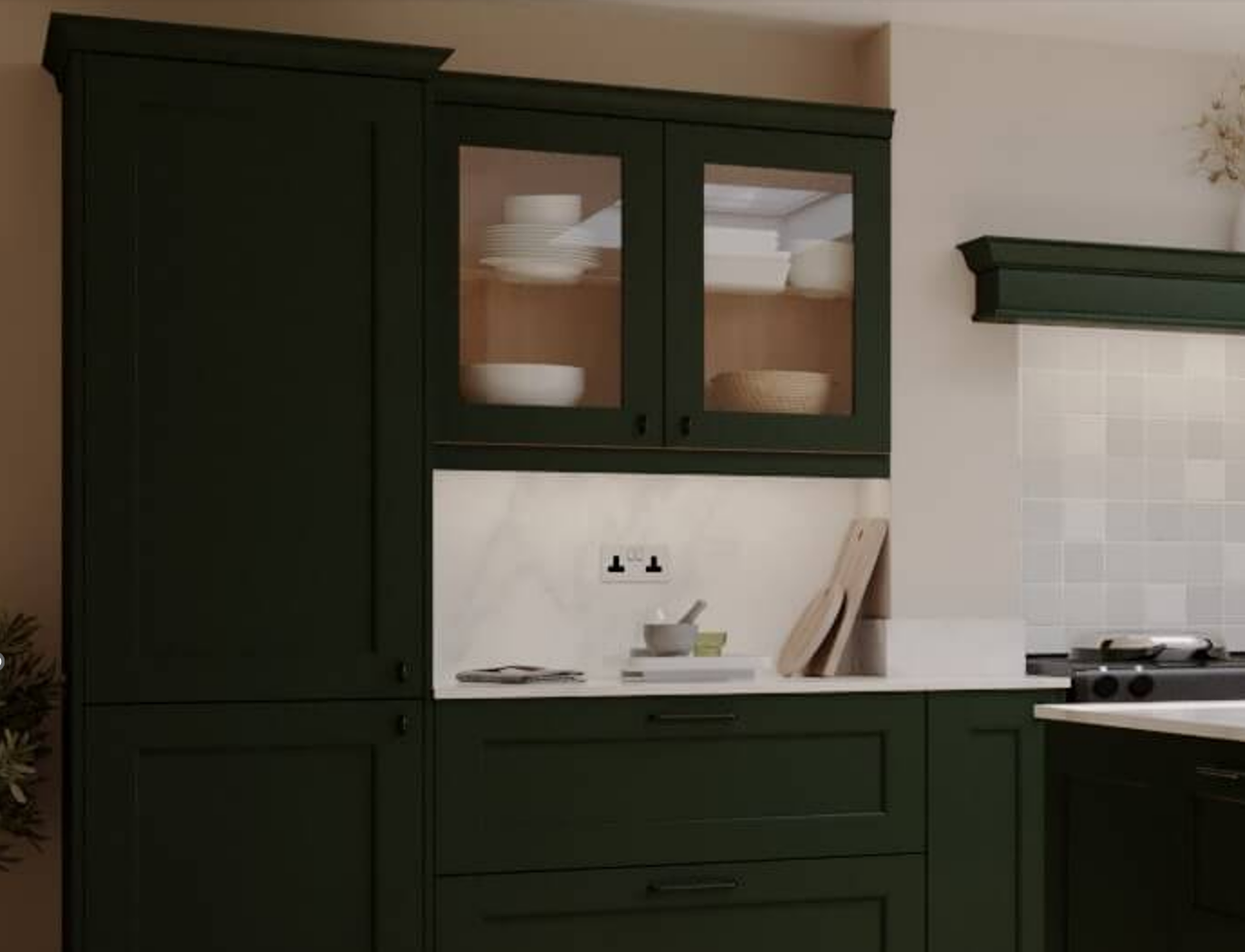
A simple, recessed panel door tends to suit this approach well, partly because it takes handles rather than relying on push-catches, and partly because it stays looking calm in a range of colours. It is worth looking at shaker kitchen design options with drawers rather than base cupboards, and specifying handles you can grip properly rather than the most minimal option available.
The Eddison shaker range in Forest, a mid-tone finish that is considerably more forgiving of daily use than high gloss.
Designing for the brain you have
The kitchens that work are not the tidiest ones. They are the ones where staying reasonably tidy takes so little effort that it happens without a decision being made.
That means accepting some visible storage, putting things where they are actually used, and choosing finishes that tolerate a normal week. If a kitchen only looks right when it is spotless, it will spend most of its life making you feel like you are failing at it. A kitchen designed around how you genuinely function will not.