
How to Keep Your Garden in Use Through Autumn and Winter
Most British gardens get about five months of use. The furniture comes out in May, the cushions go damp in September, and by the end of October the whole space is something you look at through a window until spring. That is a lot of square footage to write off for half the year, especially when the house itself feels smaller once everyone is indoors.
The good news is that keeping a garden usable in the colder months is mostly a matter of organisation rather than money. It comes down to three decisions: what you put away, what you keep out, and where you put the one thing that makes people want to sit outside when it is eight degrees.
Decide what is going away, and when
The mistake most of us make is putting the garden to bed in one weekend, or never quite doing it at all. Neither works. The first leaves you with nothing to sit on; the second leaves you with a patio full of things slowly going green.
Do it in two passes instead. In the first, clear everything that only earns its place in summer: the parasol, the paddling pool, the folding chairs that get used twice a year. Clean it, dry it properly, and store it where you will not have to move it to reach anything else. If you have no shed or garage space, a lidded bench box against the house wall holds a surprising amount, and it doubles as seating.
In the second pass, a few weeks later, look at what is left and ask whether each thing would actually be used on a cold evening. A dining table for eight probably would not. Two comfortable chairs and a small side table probably would. Keep the small set and cover or store the rest.
Keep one zone, not the whole garden
The reason most winter gardens go unused is that people try to keep all of it going. A better approach is to choose one spot, ideally close to the back door and sheltered from the prevailing wind, and treat that as the only part of the garden that needs to be ready.
Everything for that zone lives in one place: a basket of blankets just inside the door, a box of dry kindling, a torch, whatever you need so that going outside takes thirty seconds rather than ten minutes of hunting. If it takes effort to set up, nobody will bother on a Tuesday night.
Give people a reason to sit outside
Heat is the difference between a garden you use in winter and one you do not. Patio heaters do the job, but a fire is what makes people linger. It gives everyone something to look at, something to gather round, and a reason to stay for one more drink.
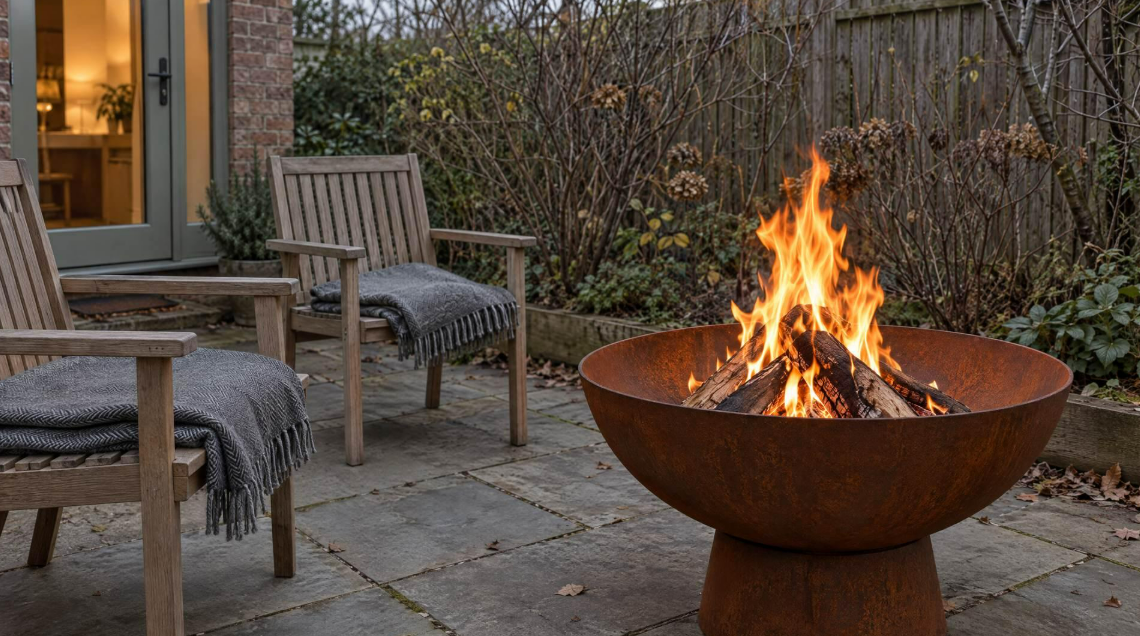
A fire pit is the simplest way to get that. The bowl designs in Alfresco Chic’s fire pit range show how much the category has moved on from the rusty dish at the bottom of the garden: weathering steel bowls that develop a warm patina over time, gas and bioethanol versions for people who want the flame without the smoke, and sizes that suit a small courtyard as well as a large lawn.
A few practical points before you buy one:
- Check your smoke control rules. Much of the UK’s urban area is covered by smoke control zones. The government’s guidance on smoke control area rules confirms that outdoor barbecues, chimineas and fire pits can be used in them, but it is worth reading the page for your own situation, and it is a reason some people choose a gas or bioethanol pit.
- Think about what it sits on. A wood-burning bowl throws heat downwards as well as out. On decking or artificial grass you will want a heat shield or a paved spot. Weathering steel also sheds a little rust in its first season, which can mark pale paving, so a gravel or dark stone base is the low-maintenance choice.
- Plan the storage before it arrives. Logs need to be dry to burn well, which means a covered store with airflow, not a pile under a tarpaulin. A single log store next to your winter zone keeps the whole thing self-contained.
Light matters more than you think
Once the clocks go back, a garden with no lighting is not a garden after five o’clock. You do not need much. A string of warm white festoon lights along a fence, a couple of solar lanterns on the table, and the glow from the fire itself will cover a small seating area. Avoid anything cold and bright; the aim is to make the zone feel like a room, not a car park.
Keep the routine simple
The gardens that get used in winter are the ones where nothing needs setting up. Blankets in the basket, logs in the store, chairs already outside under their covers. When the effort of going out is close to zero, people do it, and a cold evening round a fire turns out to be one of the better things about the season.
Do the two-pass clear-out in October, set up your one zone, and give it a heat source worth sitting next to. The rest of the garden can sleep until March.